A chimney sweep is the mechanical removal of creosote, soot, and debris from the flue lining, smoke shelf, smoke chamber, and firebox using rotary or manual brushes sized to the flue. On a wood-burning fireplace,…
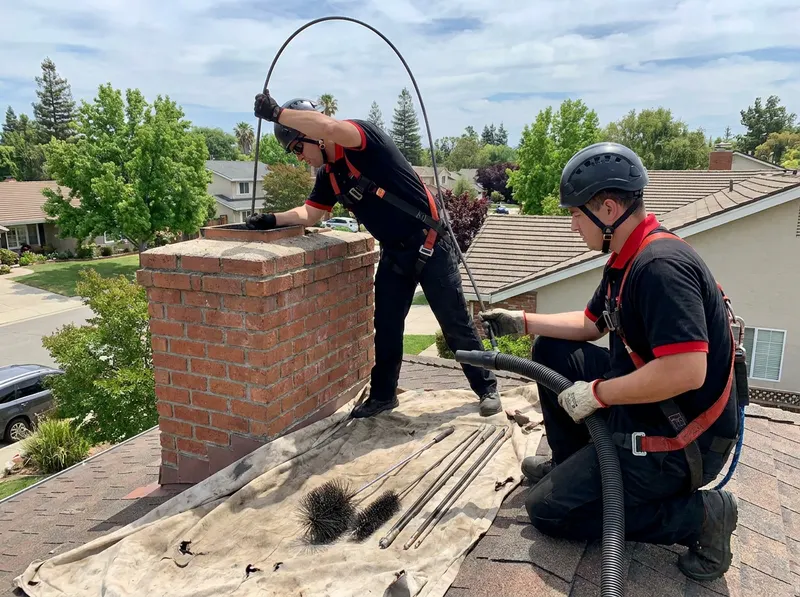
A chimney sweep is the mechanical removal of creosote, soot, and debris from the flue lining, smoke shelf, smoke chamber, and firebox using rotary or manual brushes sized to the flue. On a wood-burning fireplace, creosote is a tar-like combustion residue that ignites at roughly 1,000°F, which is why NFPA 211 sets sweeping and inspection standards for solid-fuel appliances. The Chimney Safety Institute of America (CSIA) defines a Level 1 inspection as the readily accessible visual check performed with every routine sweep, and a Level 2 inspection as the more detailed review triggered by a home sale, a chimney fire, a flue-liner change, or a video scan of the interior.
The right service depends on how the chimney is used. A gas fireplace in a Birdland or Pleasanton Meadows home burns cleaner but still needs the flue checked for bird nests, debris, and a corroded liner. A wood-burning fireplace in Vintage Hills, Kottinger Ranch, or a larger Ruby Hill or Laguna Oaks home builds creosote faster and generally warrants an annual sweep before the first cold-weather fire. If a home in Val Vista, Mohr Park, or Bonde Ranch was recently purchased and the sweep history is unknown, a Level 1 sweep with photo documentation establishes a baseline; if a chimney fire is suspected or a real-estate transfer is underway, a Level 2 inspection is the standard that applies.
Chimney sweeping and cap installation are commonly done in one visit. A missing or damaged cap lets rain, leaves, and animals into the flue, a frequent finding on older Downtown Pleasanton homes and on chimneys exposed to wind off Pleasanton Ridge. Combining the cleaning with a stainless cap install saves a second trip because the technician is already on the roof with the flue open; the cap is quoted separately from the sweep since size and material vary. The trade-off is time: a sweep alone finishes in under 90 minutes, while adding a cap adds roughly 20 to 40 minutes plus the cap part cost.
Dust control is a standard part of the work. Drop cloths cover the hearth and floor, and a HEPA-filtered vacuum runs at the firebox to capture airborne soot, so chimney cleaning in an occupied living room does not spread residue onto furniture. Before-and-after photos of the flue interior show the actual condition rather than a verbal description, which lets a homeowner see the creosote level and decide on any further work without pressure. A free on-site estimate confirms the exact price for a chimney sweep after the flue and roofline are seen in person.
Every job gets a firm, written price after a free on-site visit.
Tell us about your chimney sweep & cleaning job in Pleasanton and we'll send a clear, written quote, usually the same day.
 Fluekeeper Chimney Sweep